
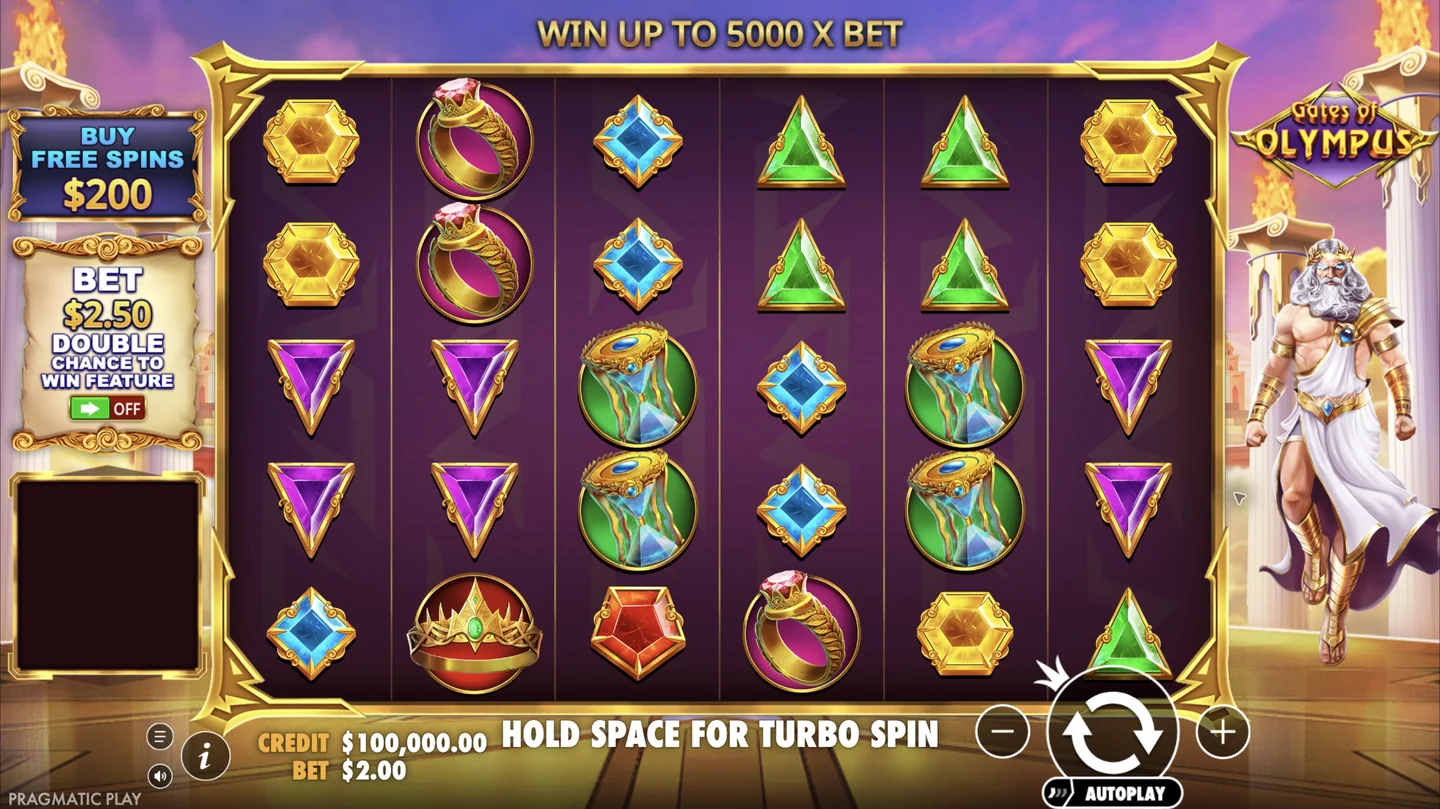



Play the original Gates of Olympus demo
This is the original Pragmatic Play slot. The demo uses a virtual balance, so its on-screen stake and winnings have no cash value. The quickest way to understand the game is to follow one complete round: look at the stake, watch for eight or more identical paying symbols, then wait for all replacement symbols to settle before reading the result. A tumble belongs to the same round. The total can therefore change several times after a single press of Spin.
Open the paytable before changing the stake. The game help shows the current configuration and explains the difference between the value of a winning group and the value printed on a multiplier gem. On a narrow screen, the play area may be easier to read with the demo expanded. If the embedded client stalls, use the reload control or open the provider’s game directly. Reloading can reset the virtual balance and interrupt a sequence.
Use the title inside the client to check the edition. A result for Gates of Olympus 1000, 2500, Super Scatter, Christmas or POP may look familiar and still launch a different slot. The demo here uses the original title’s provider identifier. A demo session can show how the controls and payouts are presented. It cannot establish the odds from a short run or tell you which configuration a real-money operator offers.
How Gates of Olympus works
Zeus stands beside six reels with five visible rows. The grid uses a count of matching symbols anywhere in view. The positions of those symbols do not have to touch, so start by counting the matching icons across the whole screen. Eight matching regular symbols is the first threshold. The paytable groups larger counts into higher payout bands and gives different values to different symbols. Eight rings and eight hourglasses can qualify under the same count rule and still pay different amounts.
After a win, the symbols that formed it disappear. The remaining symbols drop and new ones enter. The client checks the refreshed grid for another win. This continues until the tumble produces no further qualifying combination. One stake starts the sequence. Each new grid is another step in the resolution of that stake, not a new wager. If two paying groups qualify on a grid, follow the results for both groups and then read the round total.
For a simple example, suppose a grid contains nine matching chalices scattered over four reels. Their positions do not create a line, but their count qualifies. If the next grid contains seven of a different regular symbol, that group falls short of the first threshold. The screen still shows a payout from the earlier qualifying group. A visible gem with a number is a separate input to that calculation and cannot make seven symbols count as eight.
Paytable, multiplier gems and maximum win
Read the paytable from left to right as a set of conditions. Find the symbol, find the count band, then check whether the display is using money at the current stake or multiples of that stake. A symbol-value table describes an individual combination. The round total can include several combinations and a multiplier, so the largest value in a table cell answers a different question from the maximum return on an entire spin.
Pragmatic Play describes multiplier gems with values from 2× to 500×. They can appear during base play and free spins. In base play, the gems increase a qualifying tumble win and their values combine additively. For illustration, a sequence with a total of 2 virtual units and qualifying gems of 3× and 5× would be multiplied by 8, giving 16 virtual units before any applicable cap. The gems do not multiply each other to give 15×. A gem on a losing sequence is not a standalone prize. This is a worked example, not a recorded outcome.
The provider’s product description also mentions a value of up to 50× for a matching combination. This and the 500× gem ceiling refer to different parts of the calculation. The official English USD demo displays an overall maximum of 5,000× the bet. That figure applies to the client inspected here. On a base stake of two virtual units, for example, its displayed paytable gives 100 units for 12–30 crowns, or 50× the stake, before any multiplier. The 50× combination, 500× gem and 5,000× maximum describe three different things. If comparing a screenshot with a headline from another site, match the edition, stake and unit before comparing the numbers.
Free spins and the running multiplier
Four or more Zeus scatter symbols trigger a starting feature of 15 free spins. Their role is different from the regular match symbols: four scatters can open the feature even if there is no group of eight regular symbols on the same grid. Once the feature starts, the game still uses the same count and tumble rules. The change is the running multiplier displayed during the feature.
When a qualifying winning free spin contains multiplier gems, their values are added to the running total, and the resulting multiplier applies to that win. This can make a modest symbol result pay more later in a feature than it would on the first qualifying spin. The total persists within the feature. The provider describes the addition in connection with winning spins, so a gem landing on a spin with no qualifying win does not have the same effect as a gem on a winning spin.
Consider a winning free spin with a 3× gem and a second winning free spin with a 5× gem. In that simplified sequence the second addition makes the running value 8×, subject to the actual rules of the feature. When checking the screen, compare the counter before and after the tumble finishes. The effect of the feature is easiest to understand by reading the amount won and the running value separately. A higher displayed multiplier still needs an eligible win to affect the payout.
Searches for bonus buy can refer to a separate route into a feature. The inspected USD demo shows a 200-unit feature purchase at a two-unit base stake, which is 100 times the base stake. The same screen shows a separate enhanced-chance option at 2.50 units, compared with a two-unit base stake. The option and the rules attached to it can vary by configuration. The natural scatter trigger described above does not require the purchase option, and this page does not establish purchase availability by country.
RTP, volatility and version differences
Return to player is a theoretical average over many wagers in a specified game configuration. A percentage shown in the help screen describes the underlying model. Over a short session, outcomes can be far above or below it. For example, a hypothetical 96% RTP refers to an average of 96 units returned per 100 staked across the model’s long run. It does not say that a person who stakes 100 units tonight should receive 96 back. Returns include the portions of wagers paid back through wins.
The USD demo rules list 96.50% for base play, the Ante Bet and the free-spin purchase, and give a 0.20–300 virtual-unit stake range. They label the demo Medium volatility. Pragmatic Play described the original as highly volatile at launch, so we report the two labels with their sources. Its combination of hit thresholds, additional tumbles and occasional large multipliers explains why a group of spins can look very different from another group at the same stake. Volatility and RTP answer separate questions. RTP concerns the model’s average return. Volatility concerns how spread out the outcomes can be. Neither lets you schedule a win or infer from a dry stretch that a bonus is due.
Use the help panel inside the exact game you opened for a configuration-specific number. The inspected demo establishes its own RTP. For an operator’s version, consult the help in that client. If two sources disagree, compare their game symbols or edition names and check whether one figure is for a feature purchase, a different stake mode or a different operator build. The launch description and the paytable also serve different purposes. For the way wins are counted, the current product page explicitly describes pay-anywhere matches on six tumbling reels.
What practice can teach you
A useful demo session has a small goal. Open the help and locate the scatter, identify the smallest winning count, then watch how the client displays a completed sequence. Try reading the virtual balance before and after a round and compare the net change with the amount labelled as a win. A round that returns less than the stake is still a net loss even when the display announces a payout. Separating those figures is more informative than keeping a tally of celebratory animations.
There is no timing trick that makes a scatter more likely on the next spin. Changing the stake changes the amount at risk and the size of payouts expressed in money. It does not make a previous result carry forward into the next round. Streams of large wins highlight rare outcomes and usually omit long runs of ordinary or losing spins. A few hundred demo spins likewise cannot establish the payout cap, return percentage or frequency of rare features.
If you choose to gamble, set a time limit and an amount you can afford to lose before starting. Stop when you reach either limit. Increasing the stake after a loss exposes more money to another uncertain round, and extending a session because a feature feels close does not improve the odds of its next result. You can learn the rules with virtual credits and leave the game as soon as you have answered your question.
Demo access, real-money availability and promotions
The official demo is a practice version. The address or currency selected for that client gives no evidence that an operator offers the original slot where you live. A casino search may point to a site with a similar title, a differently configured game, or an offer for a particular account or location. If checking an operator’s catalogue, identify the provider and exact version in the game information and read the rules of that client.
Free spins from a scatter trigger are part of the game. A site promotion advertising free spins or a no-deposit offer is a separate arrangement with terms that can apply to particular locations, accounts and games. This review has no verified offer for the original Gates of Olympus. A promotion cannot be inferred from a free demo or from the 15 spins in the paytable. Use the free practice version if the aim is to understand the mechanics.
Sources & methodology
Checked 6 Nov 2026
Review context
Original Gates of Olympus. English desktop practice client. Checked 6 November 2026. No bets placed.
Official game page
The provider identifies the original title and links to its public practice client.
Open the provider page ↗Demo and game rules
We opened the official game identifier vs20olympgate and inspected its interface and help. The displayed settings apply to that practice session.
Launch announcement
The 2021 announcement uses a high-volatility description. The current practice client uses Medium.
Read the provider source ↗Editorial method
We checked the provider’s materials and practice rules. Worked examples illustrate the mechanics. The preview is awaiting a named reviewer and editorial sign-off.
Suggest a correction
Prepare a claim, correction and supporting source. This local preview does not submit messages.
Gates of Olympus FAQ
Can I play the demo without risking money?
Yes. The official practice client uses virtual credits. Its displayed wins cannot be withdrawn or transferred to a casino account.
Do the eight matching symbols have to be adjacent?
No. The original pays for a qualifying count anywhere on the grid. The paytable determines the amount for the symbol and the size of the group.
What starts free spins?
Four or more Zeus scatters trigger the feature with 15 free spins. Within the feature, qualifying multiplier gems can increase the running multiplier.
Is a 500× gem the same as a 500× win?
No. The gem is a multiplier applied to an eligible win under the rules. Its printed value alone does not tell you how much the round returns.
Is Gates of Olympus 1000 the same game?
It is a separate edition. Check the name and rules inside the client before comparing RTP, multipliers or maximum wins.
Can I predict when Zeus will add a gem?
The animation represents a game outcome. It offers no timing signal for the next spin. Neither a previous payout nor a run of losses makes a specific gem due.