


Sugar Rush demo: follow the marked squares
Sugar Rush is a Pragmatic Play slot on a seven-by-seven grid. Clusters of matching sweets pay, then disappear and make room for new symbols. The original game’s distinguishing feature is what happens to the squares beneath a winning group. The game marks those positions, and a later cluster that uses them can receive a multiplier. Tracking positions is a better way to read this slot than watching whichever candy has just fallen into view.
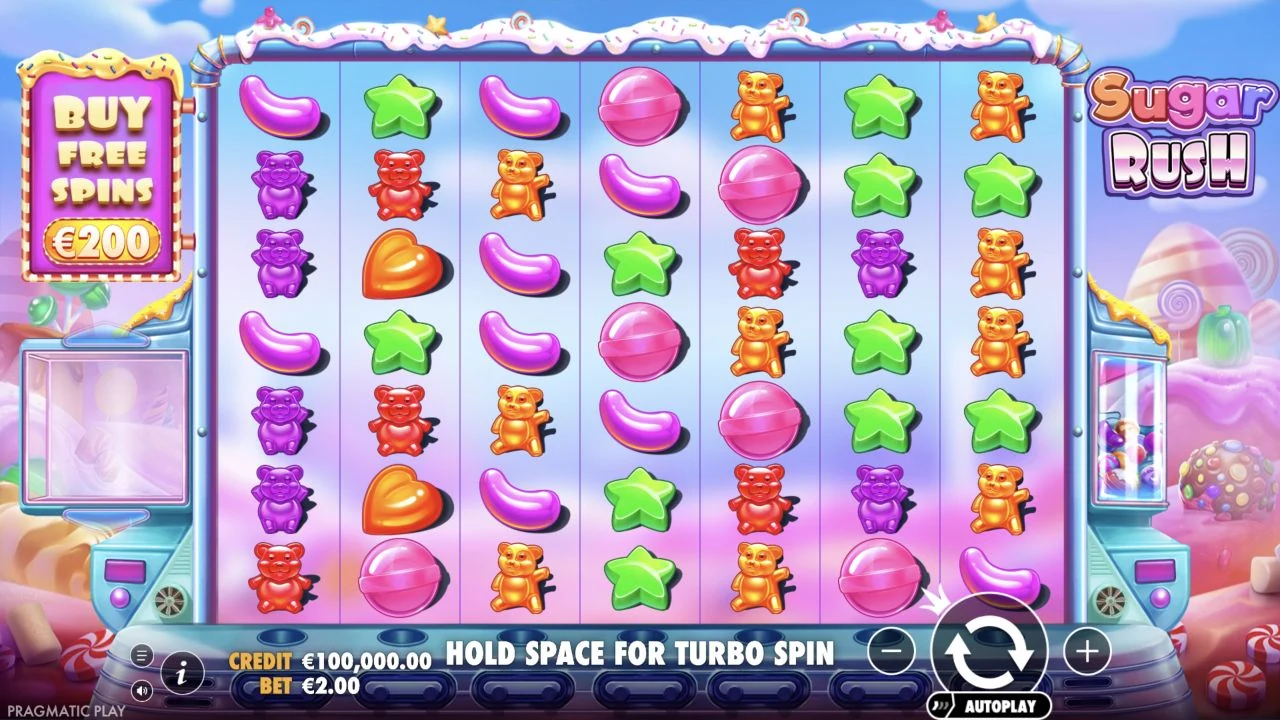
The official practice client opened in English with a virtual euro balance. Open the help icon before you start if you want to compare the rules and paytable at the same stake. The € symbol is the practice display; it does not represent a cash balance. The featured control labelled Buy Free Spins showed €200 with a €2 base bet. You can read that price and the surrounding rules without activating it.
This review covers the original Sugar Rush, identified by the provider symbol vs20sugarrush. Sugar Rush 1000 and other related titles have their own rules. If a clip or a demo has a different name on the opening screen, check which edition it covers before applying a multiplier limit or a paytable value from this guide. The official product link gives you a way to identify the original when search results mix the versions.
How Sugar Rush clusters and tumbles work
A paying cluster needs at least five identical symbols connected horizontally or vertically. Imagine four pink candies that touch along their sides and a fifth that meets the group only at a corner. The fifth does not complete a cluster. If instead it shares an edge with one of the connected candies, it can join the same group. A cluster can turn corners as long as the connection uses sides.
When a qualifying group is removed, remaining symbols drop and new symbols fill the gaps. The next board can produce another win without requiring a new paid spin. That replacement is a tumble. The sequence continues while it produces a qualifying result. To read it, check the board for groups, see which squares were cleared, then look again after the new symbols arrive. A single spin can include several such evaluations.
Use the help icon to identify each paying symbol. The scatter is a different kind of symbol: the rules count it for free spins rather than requiring a side-connected group of five. A board can contain matching candies without a payout if they are separated. Counting how many of one candy exist anywhere on the board would work in a pay-anywhere game, but does not explain Sugar Rush.
How marked positions become multipliers
The first cluster marks the positions it used. If a later winning cluster uses a marked position, that square begins at 2×; further qualifying hits can double the value to 4×, 8× and higher, up to 128× for a position. The multiplier belongs to the cell, so the new cluster can be made from a different kind of sweet. A symbol simply falling onto a marked square does not increase its value unless the square is used in a win.
For example, suppose a group of yellow sweets clears a square near the middle. A group of red sweets later wins across that same location. The mark can affect the red cluster because the rule follows the position. If the red sweets form a paying group elsewhere, that old mark does not help them. Focus on the overlap between the winning group and highlighted cells, rather than on the number of marked squares visible at once.
The rules show that when more than one multiplier applies to a cluster, their values are added for that cluster. Two active values of 2× and 4× give 6× in that example, not 8×. The whole screen is not multiplied by 6×; a different cluster is evaluated with the cells it actually occupies. This is why the final total can be hard to reconstruct from a screenshot taken after several tumbles.
Free spins and the optional buy feature
Three scatters award ten free spins in the original. Four award 12, five award 15, six award 20 and seven award 30. The trigger concerns the scatter count, independently of whether the sweets happen to form a regular cluster. Once the feature begins, check the starting spin count and watch for the first squares that get marked. Those are better reference points than the size of the first win.
In ordinary play, the marks and multipliers are tied to the current spin and its tumbles. During the free spins feature they persist between spins. Imagine one free spin leaving several marked squares but no active 2× values. The next spin can build on those marks if a new cluster occupies them. Even when a multiplier is already active, a later winning group must use its square before the value matters.
In the checked demo, Buy Free Spins was priced at 100 times the displayed base bet. That is a separate way to enter the feature where the control is offered. It does not change the side-connected cluster rule, and the cost is paid for access rather than a guaranteed return. Use the rules panel to distinguish the ordinary trigger from the buy option. Their controls and availability can differ across versions.
Paytable example and the 5,000× maximum
The paytable groups awards by symbol and cluster size. At the practice screen’s €2 base bet, the inspected table showed €300 for a pink candy cluster of 15 or more before any applicable position multiplier. That is 150 times the displayed stake in this example. The table shows the amount at the selected bet; it is not a separate figure to multiply by €2 again. A smaller cluster pays according to its own size band.
The demo’s opening screen displays a 5,000× maximum for the original game. Compare that limit with the amount for a single cluster and the 128× cap per multiplier square. All three figures have different meanings. The cluster line in the table is an award for a particular match. The multiplier changes a qualifying cluster’s award. The game maximum is an overall ceiling under the game rules.
If you see several totals during a tumble, wait for the client to finish calculating the round. A temporary label over one group may describe just that group. The total may also contain an earlier tumble or a separate cluster from the same screen. Keep the paytable stake fixed while comparing examples, or convert amounts to units of stake. That avoids confusing a larger displayed stake with a change in the rules.
Sugar Rush RTP, volatility and stake range
Page four of the English EUR practice rules showed 96.50% theoretical RTP for ordinary play. The same page listed 96.50% for the Buy Free Spins option in that client, described volatility as High and displayed a €0.20 to €240.00 stake range in virtual credits. These are observations from that session. A paid client can use different settings or omit the buy option, so check its own rules before relying on a figure.
RTP is the theoretical share of stakes returned as winnings over many rounds. It does not mean you get €96.50 back after spending €100 in one session. The high volatility label is a separate description of how uneven results can be. A cluster count, a patch of 2× cells or a full set of marked positions does not tell you what the next board will contain.
The same percentage for the base and buy modes does not make their costs or individual results alike. A base spin at the example stake uses two virtual credits; the buy price displayed was 200. Comparing outcomes without their entry costs would leave out a material difference. The practice rules are useful for seeing those prices clearly, but a few demo outcomes cannot measure the quoted theoretical percentage.
Use the demo to compare positions, not streaks
A helpful exercise is to choose one square and watch it through a tumble. Ask whether it was in the first win, what replaced its symbol and whether a later cluster used it. Then repeat the exercise in a free spin example and compare what survives the transition. You can answer those questions from the rule illustrations without trying to trigger a feature yourself. If an example is too fast, look for the first board before any symbols drop.
If you know Sweet Bonanza, notice the difference in how the games evaluate wins. That slot checks qualifying counts across the grid. Sugar Rush requires the sweets to touch by their sides. Both replace winning symbols, but here the multiplier builds at specific positions. Comparing one initial board in each game explains the difference more clearly than comparing the total at the end of a long bonus.
There is no documented way to choose which squares will be hit or time the next winning cluster. Raising a stake, switching to turbo or repeating a pattern of spins does not give you a basis for predicting where sweets will land. A practice session is useful for learning how a displayed award was assembled. It does not provide a reliable way to win or recover a loss.
Where to find the original and what is verified
The practice link leads to Pragmatic Play’s browser client. If an embedded view does not fit on a phone or a browser blocks the frame, try the provider link. We checked the English desktop client; a successful launch does not certify access from every region or on every device. The review does not require an app, a download or casino registration to read the rules.
We have no verified casino listings for this game. A country’s demand for an English demo does not establish the availability of a paid game or its buy feature there. When you check another client, compare the full title, game help and country restrictions separately. If the stakes or RTP are different, quote that version’s settings rather than treating the English practice figures as universal.
Sources & methodology
Checked 6 Nov 2026
Review context
Original Sugar Rush by Pragmatic Play. Reviewed in English on 6 November 2026.
Official game page
Provider identity, published rules and product specifications.
Open the provider page ↗Practice client check
English EUR practice client. The paytable, feature rules and RTP page were inspected. No round was played.
See the labelled game imagesEditorial method
Provider claims and practice observations are identified separately. Worked examples illustrate the rules. This preview is awaiting a named reviewer and editorial sign-off.
Sugar Rush FAQ
Is the original Sugar Rush demo free?
The official browser practice client uses virtual credits. The checked session opened without a deposit, and its demo balance and winnings cannot be withdrawn.
Do diagonally touching sweets count?
No. Five or more matching sweets need to form a group connected by sides. A corner contact alone does not join two pieces of a cluster.
How do you get free spins in Sugar Rush?
Three scatters award ten free spins. Four, five, six and seven award 12, 15, 20 and 30 respectively in the original rules.
Do multiplier marks reset after every spin?
In the base game, they last for the current spin and its tumbles. During the free spins feature, the marks and multiplier values persist between its spins.
What RTP does Sugar Rush have?
The checked English EUR demo listed 96.50% for the base game and its Buy Free Spins option. Read the rules of the exact version you open before assuming it uses the same percentage.
Is Sugar Rush the same as Sugar Rush 1000?
No. This review describes the original Sugar Rush, identified as vs20sugarrush in the official launcher. Use separate rules for Sugar Rush 1000.